www.micahimages.com

An Guide to Independent Trekking In the
Himalayas is currently being redesigned and incorporated in to a new site.
For a sneak peak at the new site see
http://www.indietrekking.com
Independent Trekking (Types of Independent Trekking, Navigation)
Having spent nearly two years in the Himalayas, much of it independently trekking throughout the region, I thought I would help others by sharing with others how to trek independently and economically in the Himalayas. Its not necessary to spend $30 to $70 a day through a travel agency in order to enjoy the splendor of these mountains as many people seem to think. All it takes is a bit of self confidence and knowledge. I've divided independent trekking into three types or styles of treks, Tea House/Homestay, Local Style (meaning basic shelter), and Full Camping. Whatever style of trek you undertake if you are going it alone you will need to learn some basic navigation and trail finding skills. The main difference between hiking in the Himalayas and hiking in North America or Europe, where most people have no problem hiking on there own, is that the altitudes are generally much higher. Since altitude affects different people differently it is important to be very conservative in your ascents if you have not been in high altitude before and do not know how it tends to affect you. Even if you have not had problems with altitude in the past it is important to remember it is always possible that you may during each new ascent. It is therefore important that anyone trekking independently be familiar with the symptoms and affects of AMS. See http://www.ismmed.org/np_altitude_tutorial.htm for a good review of symptoms and treatment of AMS.
Types of Independent Trekking
Tea House/Homestay Trekking: If you are visiting the region as part of a larger trip and don't want to lug camping gear around with you for your whole trip, or are new to trekking in the Himalayas, Tea House or Homestay trekking is a great way to enjoy the region at a reasonable price and with minimal specialized equipment. Nepal is the most well developed and easiest place to Tea House trek, specifically the Evererst, Annapurna, and Langtang regions. Several treks in Ladakh can be done as Homestay treks, while in India, the state of Uttarakhand (formally Uttaranchal) probably has the most extensive system of trekking and pilgrim Lodges. However, in general it is usually possible to stay under some sort of roof anywhere there is a permanently inhabited village, although the availability and amount of food villagers will have available to share/sell will very from region to region and season to season. The great thing about this style of trekking is that it allows one to travel light and trek for long periods without carrying heavy supplies of food. Hiking with a light bag is particularly nice at higher altitudes where each additional bit of weight is magnified with increasing altitude. In the more specific case of Homestays, trekkers are provided a unique window into the cultural life of the people in that region as they eat and sleep in the same manner as the local family. Of course the disadvantage of this style of trekking is the loss in flexibility since the routes and stopping points are dictated by places where you can eat and stay. Another knock on this style of trekking especially in Nepal is that these routes tend to be the most popular and are therefore "too touristy" and "highways of trekkers." I don't believe this is a justified criticism, I've hiked some the most popular routes in the Himalayas and never felt this was a problem. The trails are long enough that you can usually space yourself away from the big groups, and if you want to see less people choose a less popular route. I enjoy this style of trekking and I feel the ability to travel light far outweighs any of the negatives.
Equipment: Clothing (type depends on season and region), comfortable walking shoes or hiking boots, snacks (depending on availability along the route), map/guidebook, water bottle, water purification method, sleeping bag (recommended but not essential I trekked the Annapurna region without one just relying on blankets at the lodges), trekking pole or walking stick (not essential but often useful crossing rivers or going down steep descents), compass (if you don't have a good sense of direction), medical kit (tweezers, small scissors, bandages, antibiotics for diarrhea i.e. cyprofloxin, basic pain killer, cold/cough medicine, ect.)
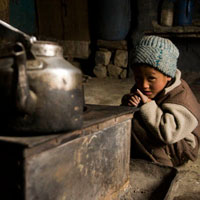
Boy at a homestay in Kargyak, Zanskar, India
Local Style Trekking: If you want a bit more flexibility than is offered by Tea House/Homestay trekking but do not have camping equipment with you, it is possible to put together a cheap trekking kit from typical items found in any Indian or Nepali market which will allow you to camp out for a few days. For shelter you can usually make do with a large plastic tarp, they are used all over India to protect street stalls from rain or as roofs of slum dwellings. A 10 ft x 10 ft tarp should cost less than 300 INR (about $6 to $7). This can be used as a roof for one of the many rock walled herder's shelters that can be found throughout the region or as a make-shift tent using rocks or nails as stakes and walking stick as a tent poll, and some rope to tie it down. A foam pad for a mattress can also be bought cheaply in most markets. Look for the places that sell it by the meter. If you are going to make do with a crude shelter you will need a good sleeping bag, preferably down. If you didn't bring one from home, the best place to pick one up in the region is Kathmandu, in India try big cities like Delhi and Calcutta which have a few specialized outdoor sports shops, else poorer quality ones can be found in Leh, and Manali. For food you can make do with dried food or if you are determined to have hot meals relatively small and light but awkward kerosene stoves can be found in every market for around 200 INR to 300 INR. This style of trekking is best for short trips (3-5 days) up into areas with no villages or lodges, or bridging gaps in homestay treks where you may need to sleep out for one or two nights. You will probably not want to go out for a few weeks sleeping under a tarp and eating dried food but I'm not saying it can't be done. However, if you are going to be that far from civilization, it would be best (and safer) to have a more substantial shelter than I've outlined here in case of unexpected bad weather.
Equipment: Clothing (type depends on season and region), comfortable walking shoes or hiking boots, food (good dry foods for trekking include: peanut butter, tin of cheese, nuts & dried fruit, biscuits, candy bars, Tang/powdered juice mix, powdered milk with musli/cornflakes), map/guidebook, water bottle, water purification method, plastic tarp, rope, large nails or tent stakes, foam mat, good sleeping bag, trekking pole or walking stick (doubles as a tent pole), compass (if you don't have a good sense of direction), medical kit (tweezers, small scissors, bandages, antibiotics for diarrhea i.e. cyprofloxin, basic pain killer, cold/cough medicine, ect.)
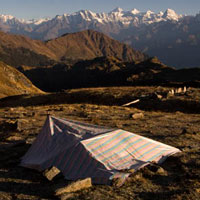
"Tarp Tent" Kuari Pass, Uttarakhand India
Full Camping: If you want to camp and hike like you would at home with with complete camping gear its best to bring your own gear from home. Failing that Kathmandu is the best place to buy camping equipment. In India try major cities like Delhi and Calcutta, but invariably you will get better priced better quality gear in your home country. You can by substandard overpriced gear in Leh and Manali. The benefit of having your own full supply of camping gear is you can pretty much go where you like, or at least where the authorities let you. Of course the draw back is carrying all your own gear and especially food is heavy and when you are crossing over 5000 m plus passes its really heavy. Food is generally the limiting factor, carrying all of your own food for much more than a week trek in the Himalayas is tough to say the least. If you are going on a longer trek where you need to be completely self sufficient it may be necessary to hire porters or pack animals.
Equipment: Clothing (type depends on season and region), comfortable walking shoes or hiking boots, food, map/guidebook, water bottle, water purification method, tent, stove (multi-fuel stove recommended for many areas do not bring one that only takes exotic clean burning fuels which are only available in the west, good sleeping bag, sleeping mat, trekking pole or walking stick, compass (if you don't have a good sense of direction), medical kit (tweezers, small scissors, bandages, antibiotics for diarrhea i.e. cyprofloxin, basic pain killer, cold/cough medicine, ect.)

Camping on Rumtse to Tso Moriri Trek, Ladakh, India
Navigation
Maps and Guidebooks: In Nepal there are a plethora of cheap good maps and guidebooks available especially for the Everest, Annapurana, and Langtang regions. For independent trekking I like the Trailblazer series of guidebooks which has books titled Trekking in the Everest Region, Trekking in the Annapurana Region, Trekking in the Langtang Region (only one edition difficult to find), and Trekking in Ladakh. The Lonely Planet Trekking in the Indian Himalaya, Trekking in Tibet, and Trekking the Nepal Himalaya are ok overviews of various treks but are of limited use when navigating. In some cases such as in the Indian Himalaya and in Tibet it may be your best bet. Another option fo the Indian Himalaya is Trekking and Climbing in the Indianan Himalaya by Harish Kapadia is similar in detail to the Lonely Planet trekking guides but cheaper and also includes outlines on how to climb some trekking peaks as well as more serious climbs. Good maps in India are much more difficult to find than in Nepal. Overall the best I've found are the Leomann Maps 1:200,000 Indian Himalaya Maps series unfortunately they have no contour lines but do have ridges, valleys and peaks indicated. They also do contain some errors in trail positions and they are not always easy to find either but if you run across them they are usually your best bet. Due to the unreliability of Indian maps its best to use a couple in conjunction with each other. For a contour map of the Himalayas you can download the U502 series 1:250,000 from . Unfortunately it is old and also not a 100% reliable and does not contain many trails.
On The Trail: In the end what you will rely on predominately to navigate is your own "trail sense." When I meet people trekking with guides and they find out I'm on my own they ask me with a shocked intonation, "How do where to go?" Its actually not to difficult I follow the big wide trail I'm on to my destination. Independent trekking is best done on well established trails that are either in significant use by organized trekking groups or locals. If you want to go along some obscure route it may be worth enlisting the services of a local guide. Of course that is if you want to go somewhere in particular. If you are well supplied you can just head of and explore as long as you confident you can retrace your steps. However, for the most part you will be trekking on well established routes. This means in general when you come to a junction most often you will want to continue on the most heavily used path especially if that junction is not on your map. Look for foot prints and pack animal dropping in addition to direction in which each trail is headed to try to determine the right trail. Many times if there is a junction not marked on your map and it looks like equal traffic on both forks then the trails will eventually merge again. If you do find yourself of a trail that doesn't seem to be right don't be too stubborn to through in the towel and retrace you steps to where you went wrong. Trails across glaciers and rocky areas are often marked with cairns (stone stacks) they can be tricky to find in some cases but with experience you will learn to pick them out. If you have gone for a while and after seeing cairns at regular intervals and do not see them anymore you probably wandered off the path, retrace your steps until you see a cairn and scan the area for the next one. The most important part of navigation on the trail is anytime you meet some one on the trail, ask and then ask to make sure you get consistent directions from multiple people. Essentially trail navigation is a mix of reading maps, common sense, and a descent sense of direction. Its really not that hard.